




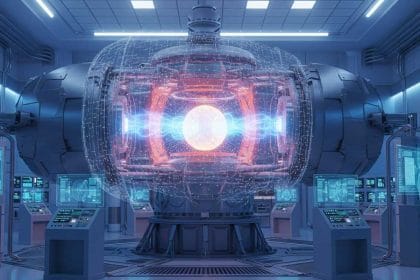
Nuclear fusion is the process that powers the Sun: light atomic nuclei join together, forming a heavier nucleus and releasing energy. On Earth, fusion is attractive because it could one day provide steady, low-carbon electricity from very small amounts of fuel. The difficult part is turning a physics reaction into a reliable power plant.
A useful way to understand fusion is this: the science is real, but commercial electricity is not here yet. Laboratories can create fusion reactions, and some experiments have reached major milestones. The remaining challenge is engineering a machine that can repeat the process, capture the energy, protect its materials, manage fuel, and do all of that economically.
What Nuclear Fusion Means in Simple Terms
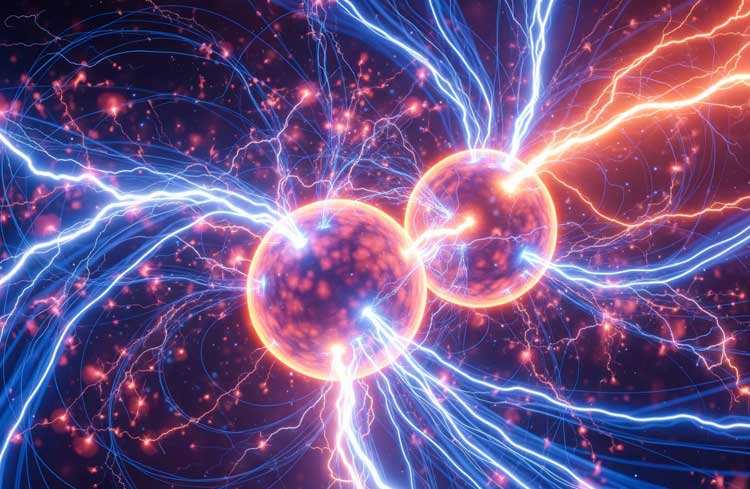
Atoms have dense centers called nuclei. In nuclear fusion, two light nuclei are forced close enough to combine into a heavier nucleus. The final products have slightly less mass than the original particles, and that missing mass is released as energy.
The best-known example is the Sun, where intense gravity creates the pressure and temperature needed for fusion. On Earth, we do not have the Sun’s gravity, so scientists use other methods: extreme heat, magnetic fields, lasers, or other confinement systems.
Most near-term fusion power concepts focus on two hydrogen isotopes:
- Deuterium: a stable hydrogen isotope that can be obtained from water.
- Tritium: a radioactive hydrogen isotope that is scarce and must be carefully produced, handled, and recycled.
When deuterium and tritium fuse, they form helium and release a high-energy neutron. A future power plant would capture energy from those neutrons as heat, then use that heat to generate electricity.
Fusion Is Not the Same as Fission
Fusion and fission are both nuclear reactions, but they work in opposite directions. Fission splits heavy atoms such as uranium. Fusion joins light atoms such as hydrogen isotopes.
| Topic | Fission | Fusion |
|---|---|---|
| Basic reaction | Splits heavy nuclei | Combines light nuclei |
| Commercial status | Used in nuclear power plants today | Still in research and demonstration stages |
| Chain reaction | Can sustain a chain reaction under reactor conditions | Requires very specific external conditions to continue |
| Waste profile | Includes spent fuel requiring long-term management | Expected to avoid spent fuel like fission, but materials can still become activated and require handling |
| Main engineering challenge | Controlling a proven reactor technology safely and economically | Creating a repeatable, efficient, durable fusion power system |
This distinction is important because fusion is sometimes described as “nuclear energy without the fission problems.” That is partly true, but too simple. Fusion has a different safety and waste profile, not zero engineering risk.
How Scientists Make Fusion Happen
Atomic nuclei are positively charged, so they repel each other. To fuse them, scientists must overcome that repulsion by creating extreme conditions. In many fusion experiments, the fuel becomes plasma, a hot electrically charged gas where electrons are separated from nuclei.
In a practical fusion machine, three conditions matter:
- Temperature: the fuel must be hot enough for nuclei to collide at high speed.
- Density: enough fuel particles must be present for collisions to happen often.
- Confinement time: the plasma must stay hot and controlled long enough to release useful energy.
Researchers often describe this balance through the idea of fusion performance: heat the fuel, hold it together, and keep losses low. If any part fails, the reaction fades.
The Main Fusion Approaches
There is no single fusion design. Different labs and companies are testing different ways to create and control the reaction.
Magnetic Confinement
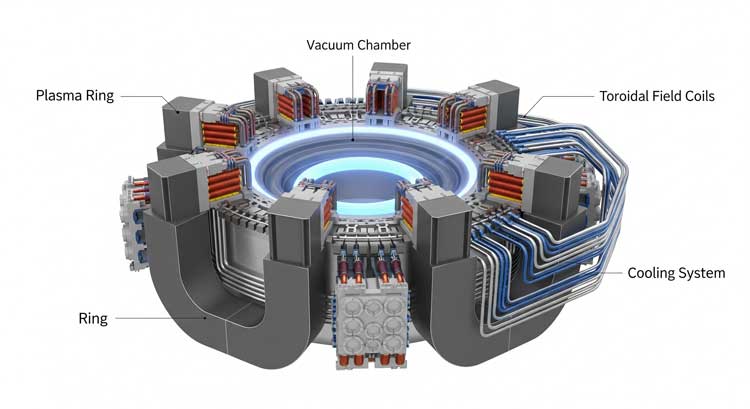
Magnetic confinement systems use strong magnetic fields to hold plasma in place. Tokamaks and stellarators are the best-known examples. The plasma is extremely hot, so it cannot simply touch a metal wall. Magnetic fields keep it suspended and shaped long enough for fusion to occur.
Tokamaks are often shaped like a doughnut. Stellarators use a more complex twisted geometry to improve stability. Both approaches aim to solve the same core problem: keep plasma hot, dense, and controlled.
Inertial Confinement
Inertial confinement uses powerful lasers or beams to compress a tiny fuel target very quickly. The National Ignition Facility at Lawrence Livermore National Laboratory is the most famous example. Instead of holding plasma for a long time, the system creates fusion in an extremely short, intense event.
This approach has produced some of the most important recent fusion headlines, but it still faces major power-plant challenges. A commercial system would need high repetition, efficient drivers, target production, energy capture, and maintenance at industrial scale.
What Fusion Ignition Actually Means
Fusion ignition is a real milestone, but it is often misunderstood. In December 2022, the National Ignition Facility achieved target gain: the fusion reaction produced more energy than the laser energy delivered to the target. LLNL reported 2.05 megajoules of laser energy delivered to the target and 3.15 megajoules of fusion energy output.
That was a landmark physics result. It did not mean the entire facility produced net electricity. The full laser system used much more energy than the laser energy that reached the fuel target, and a power plant would also need to convert heat into electricity, repeat the process many times, and operate economically.
So the honest takeaway is this: ignition proved a key part of the physics can work in the laboratory. It did not finish the engineering problem.
Why Nuclear Fusion Is So Hard
Fusion has been difficult for decades because every part of the system pushes materials, controls, and physics to extremes.
- Plasma instability: hot plasma can wobble, leak energy, or disrupt the reaction.
- Materials damage: high-energy neutrons can weaken or activate reactor materials over time.
- Tritium supply: commercial deuterium-tritium fusion would need a reliable way to breed tritium from lithium.
- Heat extraction: the machine must capture energy without destroying its own components.
- Cost: magnets, lasers, vacuum systems, cryogenics, target systems, and precision controls are expensive.
- Reliability: a power plant cannot be a one-off experiment; it must run predictably for years.
This is why fusion timelines should be treated cautiously. Private investment and better computing are accelerating progress, but commercial deployment still depends on engineering proof, regulation, cost, and grid integration.
Fuel: Deuterium, Tritium, and the Lithium Blanket
Deuterium is relatively accessible, but tritium is not. The U.S. Nuclear Regulatory Commission explains that tritium is rare, radioactive, and not available in quantities that would support large-scale commercial fusion by itself.
Many proposed fusion machines solve this by using a lithium breeding blanket. The idea is that neutrons from the fusion reaction interact with lithium around the fusion chamber, producing new tritium that can be recovered and used as fuel.
This sounds elegant, but it is one of the core engineering tests for future fusion power. A commercial plant must breed enough tritium, contain it safely, account for losses, and maintain components exposed to neutron damage.
What a Future Fusion Power Plant Would Do

If fusion becomes practical, the electricity generation side may look familiar. Fusion energy would create heat. That heat would warm a working fluid, produce steam or drive another thermal cycle, and spin turbines or generators.
The unfamiliar part is everything before that: plasma control, fuel breeding, neutron management, heat shielding, maintenance, and regulation. A future plant has to combine advanced nuclear physics with ordinary grid reliability.
This is also why fusion is different from small fission concepts such as micro nuclear power. Microreactors are based on fission designs, while fusion machines are still moving toward commercial demonstration.
Where Fusion Could Fit in the Energy Mix
If fusion reaches commercial scale, its strongest role would likely be firm low-carbon power: electricity that can run when the sun is not shining and the wind is not blowing. That would make it a potential complement to solar, wind, storage, hydro, geothermal, and existing nuclear power.
Fusion also has scientific value beyond electricity. Fusion research improves plasma physics, superconducting magnets, lasers, materials science, isotope handling, and high-performance computing. It even connects to unusual nuclear-transmutation questions, such as whether nuclear reactions can change one element into another. For that specific idea, see our separate article on mercury into gold and fusion claims.

Read Fusion Milestones Carefully
Fusion headlines can be confusing because a scientific milestone is not the same as a power plant. A plasma result, an ignition experiment, a magnet test, and a commercial grid connection are different steps on a long path.
- Scientific milestone: proves a physics point under controlled conditions.
- Engineering milestone: shows a component can survive heat, radiation, or repeated operation.
- Power milestone: produces usable electricity after losses and support systems.
- Commercial milestone: works reliably, legally, safely, and economically at scale.
This is educational science and energy context, not engineering, investment, utility, policy, or safety advice.
Bottom Line
Nuclear fusion is simple to describe and hard to build. It joins light nuclei, releases energy, and could one day provide steady low-carbon electricity. But the current state of fusion is research, demonstration, and early commercialization work, not widespread grid power.
The strongest E-E-A-T conclusion is a balanced one: fusion is not hype, and it is not solved. Ignition results, improved magnets, private investment, and better plasma control are real progress. Commercial fusion still needs reliable fuel cycles, durable materials, efficient energy capture, and economics that work outside the lab.
Sources: IAEA fusion FAQ; U.S. NRC fusion FAQ; LLNL on fusion ignition and inertial fusion energy.
Fusion Claims Need Both Science and Practical Context
Nuclear fusion is exciting because the basic reaction is real and powerful, but practical energy systems depend on much more than the reaction itself. Materials, heat handling, fuel supply, maintenance, safety design, and cost all decide whether a lab result can become a reliable power source.
For the infrastructure side, read securing nuclear fusion infrastructure. For a science-adjacent example of what fusion can and cannot realistically do, see mercury into gold using nuclear fusion. The future of materials also connects to element engineering, because advanced reactors depend heavily on materials that can survive extreme conditions.
Technical note: this is a plain-language science explainer, not engineering, safety, or investment advice. Fusion progress should be judged by repeatable performance, net energy context, durability, cost, and grid readiness, not headlines alone.