




Mercury into gold is no longer just an alchemy story, but it is also not a new way to get rich. Modern nuclear physics can change one element into another by changing the nucleus of an atom. The hard part is doing it safely, efficiently, and at a scale that makes sense outside a lab or simulation.
The recent excitement comes from a 2025 arXiv preprint that proposes using high-energy neutrons from deuterium-tritium fusion to convert mercury-198 into gold-197. That sounds like the old alchemist dream finally arriving, but the careful version is more interesting: this is a serious theoretical physics proposal, not proof that commercial fusion plants are about to flood the gold market.
Why Mercury and Gold Are So Close
Elements are defined by their atomic number, which is the number of protons in the nucleus. Gold has atomic number 79. Mercury has atomic number 80. That one-proton difference is why mercury has always looked tempting to people interested in transmutation. If a nuclear reaction can move mercury from 80 protons to 79, the result can be gold.
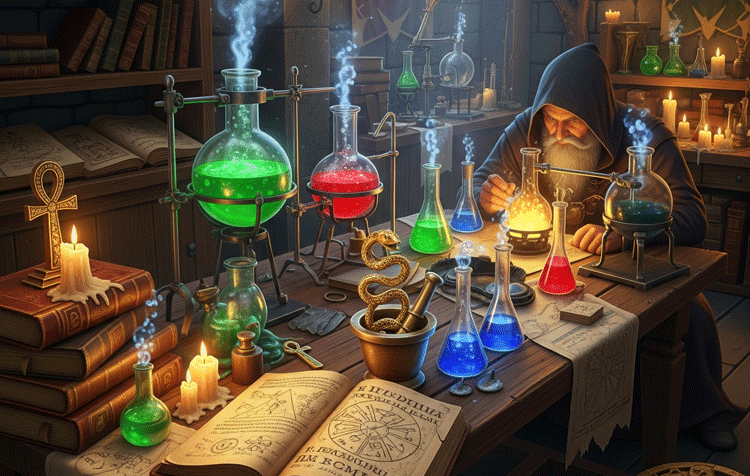
Chemistry cannot do this. Heat, acids, pressure, and ordinary laboratory reactions can change how atoms bond to each other, but they do not change the identity of an element. To turn mercury into gold, the nucleus itself must change. That puts the process in the world of nuclear reactions, particle beams, neutron bombardment, radioactive decay, and reactor engineering.
This is also why the old alchemists were aiming at the right kind of transformation with the wrong tools. They could melt, mix, dissolve, and distill metals, but they could not reach inside the atomic nucleus.
The Proposed Fusion Route
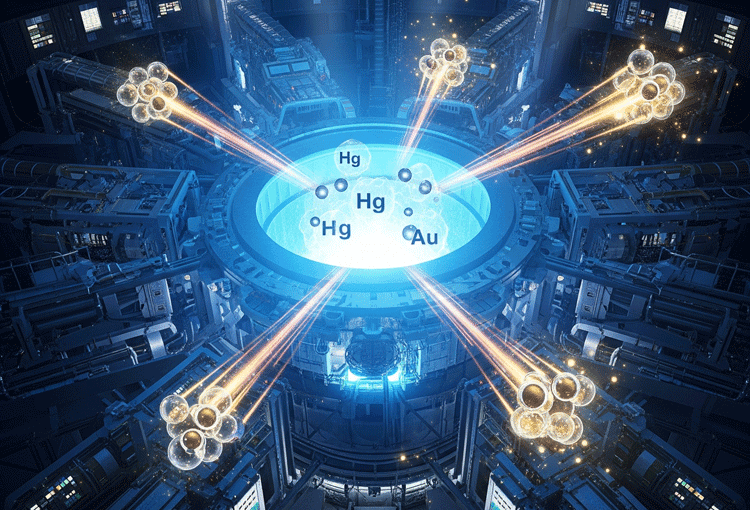
The current fusion-based idea is built around a specific isotope: mercury-198. In the proposed reaction, a fast neutron hits mercury-198 and triggers an (n, 2n) reaction. That means one neutron goes in and two neutrons come out, leaving mercury-197 behind. Mercury-197 is unstable and can decay into gold-197, which is the stable isotope of gold found in ordinary gold.
The preprint, titled Scalable Chrysopoeia via (n, 2n) Reactions Driven by Deuterium-Tritium Fusion Neutrons, argues that 14 MeV neutrons from deuterium-tritium fusion could drive this pathway inside a specialized layer of a fusion blanket. The authors estimate a production rate of about 2 tonnes of gold per thermal gigawatt-year in their simulated design.
That number is why the claim spread quickly. It suggests something very different from old particle accelerator demonstrations, where tiny quantities of atoms were changed at enormous cost. The proposal is not “make a few atoms of gold for fun.” It is “use a future fusion plant’s neutron environment to create a valuable byproduct.”
What the Claim Gets Right and What Needs Caution
The basic science of nuclear transmutation is real. Nuclear reactions can change one isotope into another, and radioactive decay can change one element into another. The cautious part is scale. A simulation or preprint is not the same thing as an operating commercial system.
| Claim | What is solid | What is still uncertain |
|---|---|---|
| Mercury can become gold | Nuclear transmutation is physically possible | Efficient bulk production is not yet demonstrated commercially |
| Fusion neutrons could drive the reaction | D-T fusion produces energetic neutrons | Blanket design, materials, extraction, and activation must be proven |
| The product can be stable gold | Gold-197 is stable | Side products and activated materials may require careful handling |
| It could help fusion economics | A valuable byproduct could matter financially | Market effects, regulatory costs, mercury handling, and reactor cost are open questions |
The most important wording shift is this: fusion is not already turning alchemy into an industrial reality. The proposal shows a plausible pathway that researchers can test and criticize. That distinction matters for trust.
Where Fusion Blankets Fit In
In many deuterium-tritium fusion designs, the plasma produces high-energy neutrons. Those neutrons do not stay neatly inside the plasma. They move into surrounding reactor structures, where engineers try to capture their energy and, in many designs, use them to help breed tritium from lithium.
The IAEA fusion FAQ explains that fusion is a nuclear process that changes atomic nuclei, and it notes that neutron activation of reactor materials is one of the important challenges for future fusion systems. The U.S. Nuclear Regulatory Commission also describes how fusion neutrons may be captured in surrounding blankets and can activate materials in the machine.
The mercury-to-gold proposal tries to turn part of that neutron environment into a useful production pathway. Instead of treating every neutron interaction as a material challenge, the idea is to place mercury in a carefully designed region where the desired reaction is encouraged. In theory, that lets the system produce electricity and gold without making gold production the main purpose of the reactor.
That is clever, but it adds engineering burden. Mercury is toxic, neutron fields are harsh, reactor blankets already have demanding jobs, and any activated material must be controlled under nuclear safety rules. A good concept still has to survive materials testing, regulatory review, maintenance planning, and economics.
The Mercury Problem
Mercury is not a harmless starting material. The EPA’s mercury information page identifies mercury as atomic number 80 and describes elemental mercury as a metal that can evaporate into toxic vapor at room temperature. It also notes that mercury exposure at high levels can harm major organs and the nervous system.
That does not make the fusion proposal impossible. Industrial and nuclear systems can handle hazardous materials when designed properly. But it does mean any serious mercury into gold system would need strong containment, monitoring, waste handling, worker protection, and emergency planning. The word “gold” makes the story glamorous; the word “mercury” is the part that makes it operationally serious.
Would the Gold Be Real Gold?
If the process produces gold-197 and the product is purified correctly, the gold is real gold. An atom of gold-197 made through nuclear transmutation is not chemically different from gold-197 mined from ore. The nucleus has 79 protons, and the surrounding electrons behave like gold.
The safety question is not whether “synthetic gold” is fake. The better question is whether the final product stream is free from unwanted radioactive isotopes and contaminants. In a reactor environment, surrounding materials can become activated. Some intermediate isotopes may be radioactive before decaying. That is why cooling time, separation chemistry, radiation monitoring, and quality control would be essential.
So the honest answer is: yes, nuclear transmutation can make real gold, but producing saleable, clean, regulated, economically sensible gold is a much bigger challenge than changing the identity of an atom on paper.
The Economics Are Not Settled
The preprint’s headline economic argument is that gold could become a valuable byproduct of a future fusion power plant. That could matter because early fusion plants are expected to be expensive. A secondary revenue stream would make investors pay attention.
But several assumptions must hold at the same time. A plant must operate reliably. The neutron economy must still support the fuel cycle. The blanket must survive. Mercury handling must be safe. The gold must be extracted without making maintenance impractical. The regulatory cost must not erase the added revenue. And if production became very large, the market price of gold could respond.
This is why the idea should be framed as a research direction, not a guaranteed business model. The same caution applies to other advanced nuclear concepts, including the wider future of nuclear fusion and broader element engineering. The physics may be elegant, but engineering decides whether it leaves the lab.
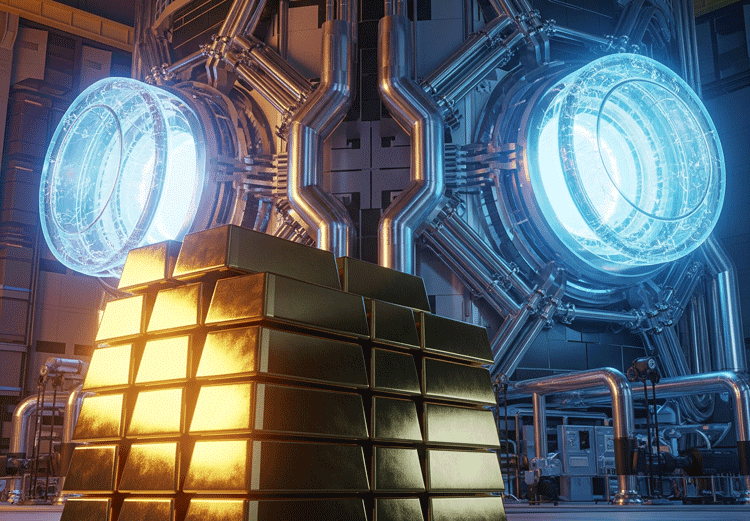
What Not to Take Away From This Claim
The practical takeaway is not that mercury should be handled at home, heated, mixed, or treated as a shortcut to gold. Mercury is toxic, and nuclear transmutation is a controlled industrial or research topic, not a DIY experiment. The more useful question is whether future fusion systems could safely manage materials, radiation, economics, and public trust. For that broader energy-risk angle, see securing nuclear fusion infrastructure.
Use a Sanity Check for Mercury-to-Gold Claims
A claim can be physically possible and still be useless as a practical gold-making method. Mercury-to-gold ideas need to pass several separate tests before they become more than interesting nuclear physics.
- Physics: does the reaction actually produce stable gold isotopes?
- Yield: how much gold appears compared with the input material and energy?
- Separation: can the product be isolated safely and economically?
- Safety: what radiation, mercury, waste, and handling risks are created?
- Economics: would the process cost more than the gold is worth?
This is educational science context, not laboratory, legal, investment, environmental, or safety advice.
Bottom Line
The idea of turning mercury into gold is scientifically real in the sense that nuclear reactions can change one element into another. The 2025 fusion-neutron proposal gives that old idea a modern path: use fast neutrons from a deuterium-tritium fusion environment to convert mercury-198 toward stable gold-197.
What is not proven yet is industrial reality. The concept still needs peer review, experimental validation, materials testing, safe mercury handling, regulatory work, and a convincing economic case. That makes the story more useful, not less. It is not magic returning under a scientific name. It is a clear example of how nuclear physics can revisit ancient questions with better tools and much higher standards of proof.
If this research progresses, the bigger story may not be cheap gold. It may be a future where advanced reactors are designed not only to make energy, but also to produce useful isotopes and materials with far more precision than old industrial chemistry ever could.
The Fusion Background Behind This Idea
Turning mercury into gold sounds strange because it sits at the edge of nuclear physics and old alchemy dreams. For the broader foundation, start with nuclear fusion explained simply, then return to why this specific transformation is technically possible but not practically useful.
When fusion moves from physics to public infrastructure, security and resilience risks around nuclear fusion become as important as the reaction itself.
Technical note: This article is general educational context, not engineering, legal, or safety advice. Real nuclear, fusion, and energy projects require qualified professionals, regulators, and local rules.