





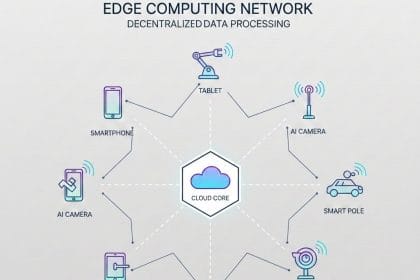
Edge computing is one of those technologies that sounds simple but gets messy fast. I’ve been reading a lot about how companies use “Edge” to process data right where it’s created—like on a factory floor or inside a smart car—rather than sending it all to a central cloud. It’s faster, it saves bandwidth, and it’s basically the future of the Internet of Things (IoT). But here’s the thing: while the technology is exciting, the “Governance” part (the rules about how that data is handled) is often a total disaster. I wanted to dive into five reasons why edge computing data governance fails so often, and what I learned about how to actually do it right.
Why Edge Governance Fails Differently
Edge computing data governance is not just smaller cloud governance. Data is created, filtered, stored, and acted on across local devices, which makes ownership, retention, access, and deletion harder to control.
A better plan defines what data is collected, where it is processed, what is sent onward, how long it is kept, who can access it, and what happens when a device is replaced, stolen, offline, or compromised.
1. The “Architecture of Chaos”: Edge vs. Cloud
In a traditional cloud setup, all your data lives in one big digital warehouse. You can put a fence around it and control who comes in and out. But Edge is different. Data is being generated and processed on thousands of tiny devices scattered everywhere. I found out that many governance models fail because they try to treat these thousands of mini-points like one big cloud. It just doesn’t work. The decentralized nature of Edge creates an “architecture of chaos” where every device becomes a potential governance leak.
| Feature | Cloud Governance (Centralized) | Edge Governance (Distributed) | The Challenge |
|---|---|---|---|
| Control Point | Single Central Server | Thousands of Remote Devices | Scaling the rules |
| Latency | Higher (Long distance) | Ultra-Low (Local) | Real-time rule enforcement |
| Security Perimeter | Clear and Fixed | Shifting and Porous | Physical device security |
| Data Velocity | Steady streams | Massive, local bursts | On-the-fly filtering |
2. Missing Frameworks: The Gaia-X Factor
One interesting thing I learned is that we’re still in the “Wild West” days of Edge standards. However, some newer frameworks are starting to emerge, like Gaia-X. This is a European initiative designed to create a secure, federated data infrastructure. Many Edge projects fail because they don’t follow a standardized framework like this. Without a set of clear rules (like Gaia-X’s focus on data sovereignty), every Edge implementation is just a one-off experiment that’s almost impossible to audit or scale securely.
3. The Real-Time Dilemma: Speed Over Structure
Edge is all about speed—reducing latency to milliseconds. But I found that this “need for speed” is often the enemy of good governance. In many projects, data is processed so fast that there’s no time to check if it meets compliance or privacy rules. Teams focus so much on the technical benchmarks (like hardware efficiency) that they forget to build in “Governance by Design.” They assume they can fix the rules later, but by then, the data has already been processed and potentially leaked.
“In edge computing, speed without structure isn’t progress; it’s just a faster way to make mistakes. Governance must be baked into the silicon, not added as a software patch later.”
— A takeaway from my research into industrial IoT security architectures.4. Physical Security: The “Out in the Wild” Risk
This is a big one that people often overlook. Cloud servers are locked in high-security bunkers. Edge devices, however, might be on top of a lonely wind turbine or hidden in a city lamppost. I learned that many governance failures happen because the physical device was compromised. If an attacker can physically access a device, they can often bypass the software governance rules you worked so hard to build. If your governance model doesn’t include the physical security of the device, it’s not a complete model.
5. Data Lifecycle Management: The “Zombies” at the Edge
Finally, there’s the issue of what happens to data once it’s processed. In a central cloud, it’s easy to delete or archive old data. At the Edge, data often lingers on devices long after it’s needed. These “zombie” data fragments are a massive risk. I found that effective governance requires a very clear lifecyle—exactly when data is created, how it’s filtered, and exactly when it is permanently deleted at the source. If you don’t know when to say goodbye to your data, you’re just hoarding risk.
Conclusion: Building a Scalable Foundation
Edge computing is incredibly powerful, but its power comes with a new kind of responsibility. I’ve realized that successful Edge projects are the ones that treat data governance as a technical requirement, not a legal chore. By looking at emerging frameworks like Gaia-X and focusing on “Governance by Design,” we can build Edge systems that are not only fast but also secure and trustworthy. The future is at the Edge, but only if we bring the right rules with us.
Technical Note: This post explores the architectural challenges of decentralised data governance. I’ve synthesized these points from industrial IoT Whitepapers and emerging federated data standards. The goal is to provide a relatable entry point into a very complex technical field.
Governance Checks Before Moving Data to the Edge
Edge data governance starts with classification. Decide which data can stay on the device, which data can be summarized, which data must be encrypted, and which data should never leave the user environment. Retention, deletion, access control, audit logs, and vendor responsibilities matter as much as latency.
For the foundation, start with edge computing. For privacy in connected homes, compare this with smart home privacy. For account and device protection, read future digital security. NIST also keeps a useful Privacy Framework for thinking about privacy risk.
Governance Is the Missing Layer in Edge AI
Moving computation closer to the user can reduce latency and sometimes improve privacy, but it does not automatically solve data governance. A system still needs clear choices about what is collected, what is processed locally, what is synchronized, and how errors are audited. That is why this topic belongs beside the broader edge computing explainer.
In consumer products, the same issue appears as smart home privacy: cameras, sensors, speakers, and hubs can feel local while still depending on accounts, cloud logs, or remote model updates. Edge AI is useful only when the data path is understandable.