






Central Bank Digital Currencies, or CBDCs, are digital forms of central bank money. In plain English, a CBDC would be an official digital version of a country’s currency, issued by the central bank rather than by a private bank, card network, crypto company, or stablecoin issuer.
CBDCs are controversial because they combine payments technology with public money, privacy, banking stability, cybersecurity, and monetary policy. The right question is not simply “Are CBDCs good or bad?” It is “What kind of CBDC, under which legal safeguards, with what privacy rules, and for which problem?”

What Is a CBDC?
The Federal Reserve defines a CBDC as a digital form of central bank money that is widely available to the general public. In the United States today, the public has physical Federal Reserve notes, while banks hold digital balances at the Federal Reserve. A retail CBDC would create a new public-facing form of digital central bank money.
The Bank for International Settlements makes a similar distinction: banknotes are public money available to the public, while most digital money people use today is private money, such as commercial bank deposits or e-money balances.
This is the key difference: a CBDC would be a liability of the central bank. A bank deposit is a liability of a commercial bank. A stablecoin is usually a private token backed by reserve assets or collateral. A cryptocurrency like Bitcoin is not issued by a central bank at all.
CBDCs vs Stablecoins vs Cryptocurrency
| Type of money | Issuer | Primary risk question |
|---|---|---|
| CBDC | Central bank | Privacy, governance, access, banking impact, cybersecurity |
| Bank deposit | Commercial bank | Bank safety, deposit insurance limits, account access |
| Stablecoin | Private issuer or protocol | Reserve quality, redemption, issuer risk, regulation, platform risk |
| Cryptocurrency | Network or protocol | Volatility, custody, network security, regulation, adoption |
For the private-token side, read our guide to stablecoins and their risks. The two topics overlap, but they are not the same thing.
Retail CBDC vs Wholesale CBDC
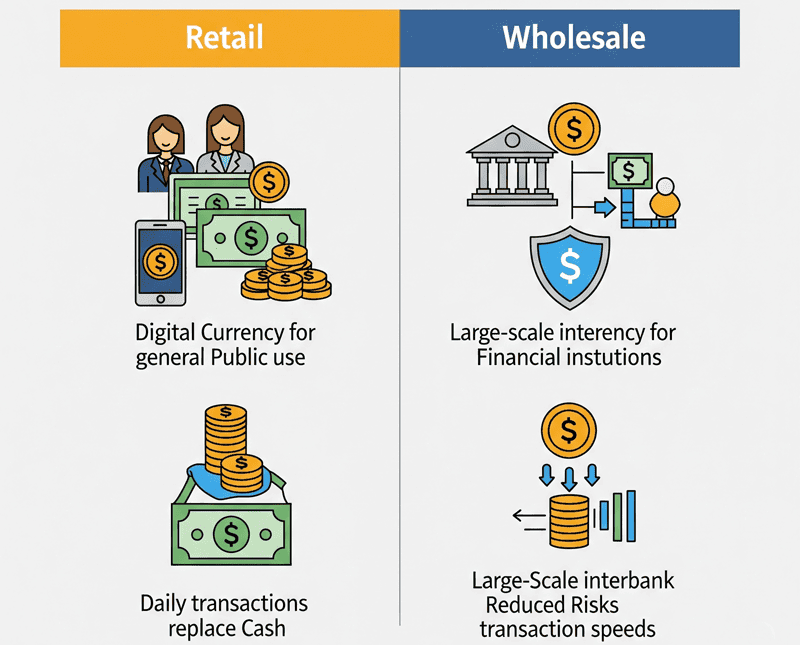
Most CBDC discussions fall into two categories:
- Retail CBDC: designed for the general public, businesses, and everyday payments.
- Wholesale CBDC: designed for banks, financial institutions, securities settlement, and large-value transfers.
Wholesale CBDCs may be less visible to ordinary users because they focus on settlement infrastructure. Retail CBDCs are more politically sensitive because they can affect privacy, bank deposits, payment apps, cash use, and consumer access.
How a CBDC Could Work
There is no single CBDC design. A central bank could choose an account-based model, token-based model, intermediated model, direct model, centralized ledger, distributed ledger, or hybrid system. Those design choices determine the real impact.
A CBDC system may include:
- central bank issuance and redemption rules
- wallets or accounts for users
- banks or payment providers acting as intermediaries
- identity checks and anti-money-laundering controls
- privacy safeguards and transaction limits
- offline payment features, if supported
- cybersecurity and operational resilience requirements
Not every CBDC uses blockchain. Not every CBDC is anonymous. Not every CBDC replaces cash. The architecture depends on policy goals.
Direct, Intermediated, and Hybrid Designs
A direct CBDC would mean the central bank provides accounts or wallets directly to the public. That model gives the central bank a large operational role, but it could compete with commercial banks and private payment providers.
An intermediated CBDC is different. In that model, the central bank issues the digital money, but banks or payment companies provide wallets, customer service, compliance checks, and user-facing apps. Many policy discussions lean toward intermediated models because they preserve more of the existing banking structure.
A hybrid design tries to combine central bank settlement with private-sector distribution. This is why CBDC debates are often more about institutional design than blockchain. The same “digital dollar” label can describe very different systems.
Potential Benefits
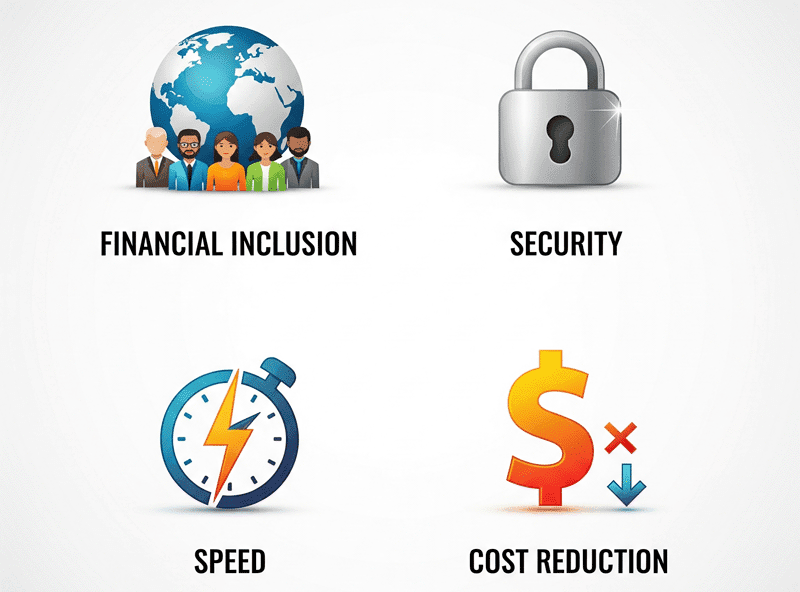
Supporters often point to several possible benefits:
- Public digital money: a digital payment option backed by the central bank.
- Payment efficiency: faster or cheaper payments in countries with slower systems.
- Financial inclusion: simpler digital payment access if onboarding is low-cost and accessible.
- Cross-border experimentation: wholesale CBDC systems may improve settlement between institutions.
- Resilience: a public payment rail could complement private payment networks.
- Programmability: some systems may support rules-based payments, though this raises governance concerns.
These are potential benefits, not automatic results. A CBDC will not improve payments if it is inconvenient, poorly trusted, expensive to use, or weaker than existing systems.
Key Risks and Criticisms
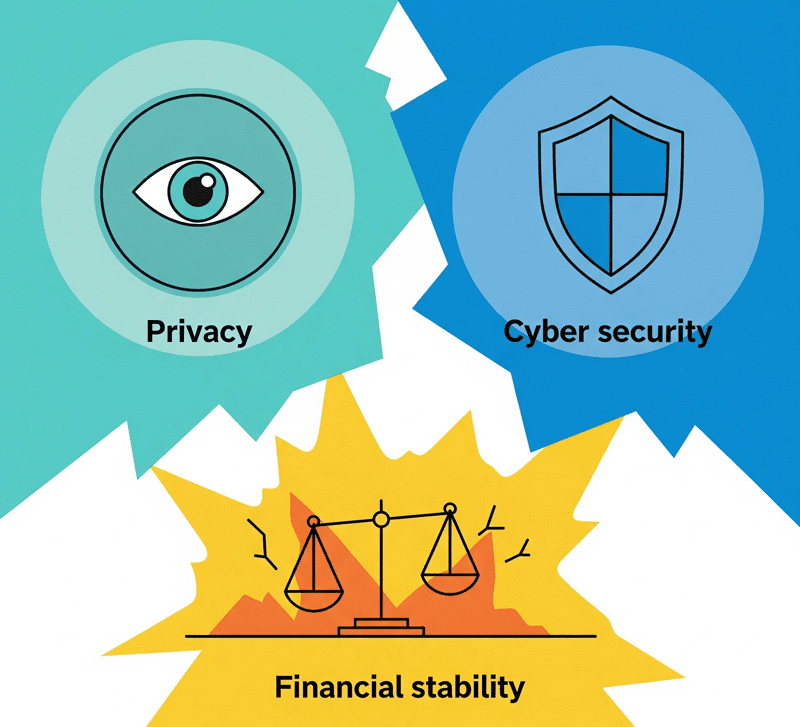
CBDCs also raise serious concerns:
- Privacy: weak safeguards could increase transaction surveillance.
- Cybersecurity: national payment infrastructure would be a high-value target.
- Banking impact: if users move deposits from banks into CBDC wallets, bank funding could be affected.
- Operational outages: a technical failure could disrupt payments at scale.
- Government control concerns: programmability and restrictions could be misused without legal limits.
- Adoption risk: people may simply prefer existing cards, bank apps, cash, or private payment tools.
These concerns explain why CBDC debates often become political. The technology is only one part of the issue. Legal design, governance, oversight, and civil-liberties protections matter just as much.
Privacy Design: The Hardest Trust Problem
Privacy is usually the most sensitive CBDC issue. Physical cash allows small everyday payments without creating a detailed digital record for every transaction. A CBDC could be designed with strong privacy protections, but it could also be designed in a way that creates much more visibility for governments or intermediaries.
Some proposals discuss tiered privacy, where low-value payments receive stronger privacy while higher-value transactions require more identity checks. Others discuss offline payments, transaction limits, or privacy-preserving cryptography. None of these choices are automatic. They must be written into the law, the technical design, and the operating rules.
That is why a serious CBDC proposal should explain who can see transaction data, when law enforcement can access it, whether intermediaries can monetize it, how long data is stored, and what rights users have to challenge misuse.
Offline Payments and Financial Inclusion
One promised benefit of CBDCs is financial inclusion, but inclusion depends on design. A CBDC that requires a modern smartphone, constant internet, formal ID, and bank-like onboarding may not help people who are already excluded from digital finance.
Offline capability could matter in rural areas, disasters, or places with weak connectivity. Simple wallets, low fees, accessibility for older users, disability-friendly design, and cash-conversion options also matter. A CBDC built only for people who already have easy digital banking access may not solve the inclusion problem.
Has the United States Decided to Launch a CBDC?
No. The Federal Reserve states that it has made no decision on whether to pursue or implement a CBDC. It has researched potential benefits and risks, but a U.S. CBDC would require broad policy support and legal authorization.
This matters for readers because many online claims describe a U.S. CBDC as already launched or guaranteed. That is not accurate as of April 13, 2026. Research and debate are real; implementation is not decided.
Why Countries Approach CBDCs Differently
Countries study CBDCs for different reasons: payment modernization, declining cash use, financial inclusion, cross-border settlement, monetary sovereignty, competition with private stablecoins, or strategic digital infrastructure.
That means one country’s pilot does not predict another country’s design. A small-island payment system, a large advanced economy, and a country with limited banking access may need very different CBDC models.
What CBDCs Could Mean for Stablecoins and Banks
CBDCs may also affect private digital money. If a country offers a trusted public digital currency, some users may prefer it over private stablecoins for payments. On the other hand, stablecoins may continue to serve crypto markets, cross-border transfers, and private-sector payment integrations where CBDCs are not available or not interoperable.
Commercial banks are another major question. If households can hold large balances directly in central bank digital money, bank deposits could become less stable during stress. Many CBDC designs try to reduce this risk through holding limits, tiered interest, or intermediated access through banks.
This is why CBDCs are not only a consumer technology. They can affect the structure of the financial system, the role of banks, and the relationship between public and private money.
CBDC Design Choices Decide the Trade-Offs
A CBDC is not one fixed product. The real debate depends on design: who can hold it, who runs wallets, whether offline payments work, how identity is checked, how privacy is protected, and whether banks still keep their deposit role.
- Retail or wholesale: public wallets and bank settlement systems solve different problems.
- Direct or intermediated: central bank wallets create different trust questions from bank or payment-provider wallets.
- Privacy design: small everyday payments, law-enforcement access, and anti-fraud rules need clear boundaries.
- Bank impact: easy movement from deposits to CBDC could affect funding, lending, and crisis behavior.
This is educational financial technology information, not financial, legal, tax, policy, or investment advice.
- For the direct comparison, use the CBDC vs stablecoin guide.
Bottom Line
A CBDC is central bank money in digital form. It could modernize payment infrastructure in some countries, but it also raises hard questions about privacy, cybersecurity, bank deposits, legal safeguards, and trust.
The strongest way to evaluate any CBDC proposal is to ignore slogans and inspect the design: retail or wholesale, anonymous or identified, direct or intermediated, cash replacement or cash complement, optional or required, and protected by what law.
Sources: Federal Reserve CBDC FAQ; Federal Reserve CBDC research page; BIS CBDC executive summary; IMF CBDC resources.
CBDCs Sit Inside a Wider Digital Money Shift
CBDCs are easiest to understand when they are compared with the other forms of digital money people already hear about. A CBDC is issued by a central bank, while stablecoins, crypto payment networks, bank apps, and DeFi tools come from different public or private systems.
The adoption problem is partly technical, but it is also about trust. That is why the related article on why CBDCs struggle with adoption matters. For the private-sector side of the same shift, compare CBDCs with stablecoins explained, how DeFi is changing banking, and the broader digital banking shift.
Reader note: this is an educational technology and policy explainer, not financial, legal, or investment advice. Digital money rules, consumer protections, and privacy expectations can vary by country and change over time.
Where CBDCs Fit Beside Stablecoins and Digital Banking
A CBDC is easiest to understand when it is compared with nearby systems rather than treated as a standalone buzzword. A government-issued CBDC is different from stablecoins, which are usually private tokens designed to track another asset. It also differs from neo-banking technology, where the user experience changes but the money may still sit inside the existing banking system.
The practical question is not whether digital money sounds modern. It is who controls issuance, who can freeze or reverse access, what privacy model exists, what happens offline, and how the system connects with payments, custody, and decentralized finance.
Finance note: This guide is educational only. It does not recommend using, avoiding, buying, or holding any digital currency or crypto asset.