






As we move deeper into the digital age, the demand for faster, more reliable connectivity continues to grow. 5G networks are one of the most important upgrades behind that shift. More than a simple step up from 4G, 5G is reshaping how people, devices, and systems communicate in real time across homes, cities, and industries.
From mobile streaming and cloud gaming to smart factories and connected vehicles, 5G is becoming a core layer of modern infrastructure. In this guide, you will learn what 5G networks are, how they work, where they are already making an impact, and what challenges still affect global rollout.
Understanding 5G Networks
5G stands for fifth-generation wireless technology. It is designed to deliver much faster data speeds, lower latency, and much higher device capacity than previous generations. In practice, this means smoother video calls, quicker downloads, more stable connections in crowded areas, and better support for machine-to-machine communication.
What makes 5G different is not only speed. It is the combination of speed, responsiveness, and scalability. That combination enables use cases that were difficult or too unreliable on older networks, especially in healthcare, transportation, industrial automation, and smart city infrastructure.
Key Features of 5G Technology
- Faster Speeds: 5G can deliver much higher peak and average data rates than 4G, depending on spectrum, coverage, and device capability.
- Lower Latency: Reduced delay improves real-time responsiveness for applications like remote control systems, gaming, and industrial automation.
- Massive Device Connectivity: 5G is designed to support dense IoT environments, including sensors, cameras, and smart infrastructure.
- Network Slicing: Operators can create virtual network slices for different use cases, such as consumer traffic, industrial systems, or emergency services.
These features are important for consumers, but they are even more strategic for businesses and governments building digital infrastructure for the next decade.
Real-World Applications of 5G
5G networks are already influencing multiple industries by improving speed, reliability, and machine communication.
Healthcare
5G supports high-quality telemedicine, remote diagnostics, connected medical devices, and faster transfer of imaging data. In some settings, it also improves the reliability needed for robotics-assisted care and real-time monitoring.
Transportation
Connected vehicles benefit from faster communication with traffic systems, cloud platforms, and nearby infrastructure. This helps improve navigation, fleet efficiency, and road safety systems, especially in urban environments.
Manufacturing
In smart factories, 5G enables low-latency machine coordination, sensor-heavy monitoring, automated quality checks, and real-time analytics. It can also reduce dependence on wired networks in flexible production lines.
Entertainment and Media
For users, 5G improves streaming consistency, mobile gaming performance, and AR/VR experiences. For creators and broadcasters, it can support faster uploads, remote production workflows, and live event connectivity.
How 5G Supports Emerging Technologies
One of the strongest advantages of 5G is how it amplifies other technologies, especially edge computing and IoT. High-speed, low-latency communication allows devices to process and exchange data closer to the source, which improves response times and reduces bandwidth strain on centralized systems.
This is especially relevant for applications like smart cameras, industrial robots, autonomous drones, and predictive maintenance systems. For a deeper look at this relationship, read our guide to edge computing.
Challenges Facing 5G Implementation
Despite the benefits, global 5G rollout is not simple. Deployment quality varies by country, carrier investment, spectrum policy, and local infrastructure.
- Infrastructure Costs: Expanding coverage often requires dense small-cell deployments, fiber backhaul, and major capital investment.
- Spectrum Strategy: Performance depends heavily on available low-band, mid-band, and high-band spectrum, each with different trade-offs in speed and coverage.
- Security Expansion: More connected devices and distributed network architecture increase the attack surface, requiring stronger security and monitoring.
- Coverage Gaps: Urban areas often receive upgrades first, while rural or lower-density regions may lag behind.
- Device Compatibility: Users need compatible phones, modems, and plans to fully benefit from advanced 5G capabilities.
Global Developments in 5G Adoption
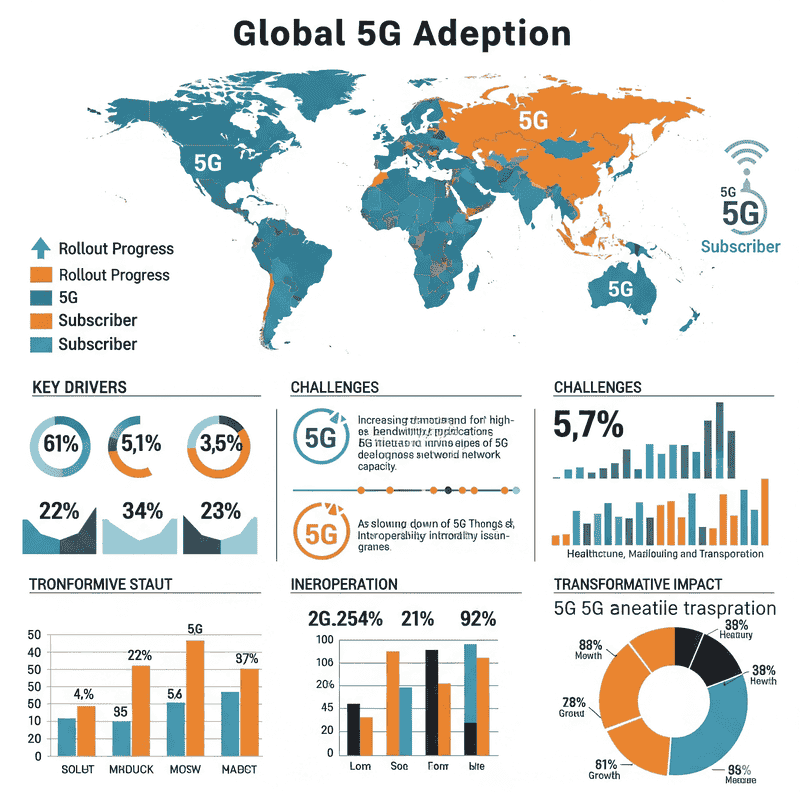
5G adoption continues to expand worldwide, with strong momentum in parts of Asia, North America, and Europe. Markets differ significantly, though, in terms of 5G standalone deployment, coverage depth, and enterprise use cases. As operators move beyond early consumer marketing, attention is shifting toward network quality, industrial applications, and long-term monetization.
Industry groups such as GSMA and standards bodies like 3GPP play a central role in tracking rollout progress and shaping future upgrades, including 5G Advanced.
The Future of Connectivity
5G is increasingly becoming a foundational platform for digital transformation. It supports smart cities, connected infrastructure, private enterprise networks, and real-time digital services that depend on reliable wireless performance. In many sectors, 5G is less about faster phone internet and more about enabling entirely new operating models.
Organizations that invest strategically in 5G-ready systems today are better positioned to benefit from automation, data-driven operations, and next-generation services in the years ahead.
Conclusion
5G networks represent a major shift in connectivity, not just a routine mobile upgrade. With faster speeds, lower latency, and support for massive device ecosystems, 5G is helping power the next phase of digital innovation across consumer and industrial environments.
While rollout challenges remain, the long-term direction is clear. Understanding 5G today helps you understand the infrastructure behind tomorrow’s healthcare systems, smart factories, connected transport, and immersive digital experiences.