




Eco-friendly inventions can help reduce waste, cut emissions, save water, and make daily life less resource-intensive. But not every green idea is ready to “save the planet,” and not every impressive prototype becomes affordable at scale.
A better way to judge eco-friendly inventions is to ask four questions: Does it solve a real environmental problem? Can it scale? Does it avoid shifting harm somewhere else? And can normal people, cities, or businesses actually use it? With that standard, the strongest inventions are often practical rather than flashy.
How to Judge an Eco-Friendly Invention
Before listing examples, it helps to separate useful innovation from green marketing. A credible eco-friendly invention should have a clear impact pathway, such as reducing energy use, replacing fossil fuels, preventing waste, improving recycling, protecting water, or making materials last longer.
| Question | Why it matters |
|---|---|
| What problem does it solve? | Green claims are weak if the environmental benefit is vague |
| What is the full lifecycle impact? | A product can look clean during use but create waste or emissions elsewhere |
| Can it scale affordably? | Prototypes matter, but broad impact requires deployment |
| Who can use it? | Household, city, farm, factory, and grid solutions have different barriers |
1. Affordable Solar Photovoltaics
Solar panels are no longer a futuristic invention; they are a mainstream clean-energy technology. Their importance is practical: they turn sunlight into electricity without burning fuel during operation. The U.S. Department of Energy explains that photovoltaic cells convert sunlight directly into electricity, making solar one of the core tools for cleaner power systems.
The next wave is not only better panels. It includes cheaper installation, improved inverters, smarter grid integration, recycling for old panels, and pairing solar with batteries. For homes, the best first step is still a realistic energy plan rather than buying equipment blindly.
2. Grid-Scale and Home Battery Storage
Renewable electricity becomes more useful when it can be stored. Batteries help smooth solar and wind output, support backup power, and reduce reliance on fossil fuel peaker plants. At home, a battery can also support resilience during outages.
Battery storage is not impact-free. Mining, manufacturing, safety, recycling, and cost all matter. But better storage is one of the key inventions that makes renewable energy more dependable. It also connects with safer battery design and better end-of-life recycling.
3. Heat Pumps
Heat pumps are one of the most practical climate technologies for buildings. Instead of creating heat by burning fuel, they move heat. In the right setting, that can make heating and cooling more efficient than many traditional systems.
The important caveat is fit. Climate, insulation, electricity prices, refrigerant choice, and installation quality affect results. A heat pump is strongest when paired with weatherization, good controls, and a right-sized system.
4. Smart Thermostats and Building Controls
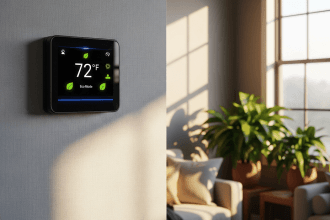
Some eco-friendly inventions are small but effective because buildings waste so much energy through poor control. Smart thermostats, occupancy sensors, efficient lighting controls, and smart plugs can reduce wasted heating, cooling, and electricity use when configured correctly.
For practical home savings, see our guide to smart thermostat savings. The key is behavior plus automation. A device that is never configured will not save much.
5. Low-Waste Packaging Materials
Packaging innovation matters because plastic waste is visible, persistent, and widespread. Better packaging can include reusable systems, refill models, paper-based designs, compostable materials where composting infrastructure exists, and packaging reduction before material substitution.
The strongest solution is often “use less packaging” rather than “replace every package with a new material.” Compostable packaging is only useful if it goes to the right facility and does not contaminate recycling streams.
6. Advanced Recycling and Material Recovery
Mechanical recycling has limits, especially for mixed, contaminated, or multi-layer materials. Advanced sorting, chemical recycling, improved material labeling, and better collection systems aim to recover more value from waste.
This category needs careful scrutiny because some technologies are overpromised. A strong recycling invention should prove real recovery, reasonable energy use, safe outputs, and a market for the recovered material.
7. Vertical Farming and Controlled-Environment Agriculture
Vertical farming can grow certain crops in stacked indoor systems using controlled light, nutrients, water, and climate. Its advantages can include local production, reduced pesticide use, and efficient water recirculation.
The limits are also real. Energy use can be high, and vertical farms are better suited to leafy greens and herbs than staple crops. The technology is most promising where land, water, transport distance, or climate constraints make conventional production difficult.
8. Water-Saving Fixtures and Leak Detection
Water-saving inventions are often simple: efficient showerheads, faucet aerators, dual-flush toilets, smart irrigation controllers, soil moisture sensors, and leak sensors. EPA WaterSense programs show how labeled products can help consumers identify water-efficient fixtures.
For households, water savings often start with leaks and outdoor irrigation, not exotic technology. See our guide to simple water conservation at home for practical steps.
9. Indoor Composting and Food Waste Tools
Food waste is an environmental problem because growing, transporting, refrigerating, and discarding food all use resources. Composting tools, food-storage containers, smart inventory apps, and municipal collection systems can help reduce waste.
Indoor composting is a practical option for apartments when done correctly. Worm bins, Bokashi, electric pre-processors, and drop-off programs each fit different households. The best invention is the one that keeps food scraps out of normal trash and still has a real destination for the output.
10. Direct Air Capture and Carbon Removal
Carbon removal technologies aim to remove carbon dioxide from the air or store carbon in durable forms. Direct air capture is the most famous example, but nature-based and mineralization approaches are also part of the field.
This is not a substitute for reducing emissions. It is a possible complement for hard-to-abate sectors and legacy emissions. The main challenges are cost, energy use, verification, and permanent storage.
Score an Eco-Friendly Invention Before Believing the Hype
The best eco-friendly inventions are not just clever. They reduce a real environmental burden, work at a useful scale, avoid shifting harm somewhere else, and can be adopted without requiring perfect behavior from everyone.
- Problem size: does it address energy, water, food, transport, materials, or waste at meaningful scale?
- Lifecycle impact: do manufacturing, maintenance, disposal, and supply chains still make sense?
- Adoption path: can ordinary homes, cities, farms, or businesses actually use it?
- Proof level: is it a lab result, pilot project, commercial product, or widely deployed system?
- Greenwashing risk: does the marketing hide costs, trade-offs, or tiny real-world impact?
This is educational sustainability context, not engineering, investment, purchasing, tax, rebate, or policy advice.
- For cleaner household energy decisions, compare inventions with green home energy.
- If the claim is about materials, use eco-friendly materials as a reality check.
- If the claim sounds too clean, test it against greenwashing signals.
Bottom Line
The most useful eco-friendly inventions are not always the most dramatic. Solar power, storage, heat pumps, smart controls, water-efficient fixtures, composting tools, better packaging, recycling improvements, vertical farming, and carbon removal all have roles, but each has limits.
The practical standard is impact, scale, and honesty. A green invention should reduce real environmental harm without hiding trade-offs. For everyday action, start with lower energy use, less waste, water efficiency, and buying fewer products you do not need.
Sources: EPA reducing and reusing basics; U.S. DOE solar basics; EPA WaterSense; EPA composting at home.
Materials Innovation Still Needs Proof
Eco-friendly inventions often depend on materials that sound futuristic before they become practical. Graphene is a good example: the basic science is impressive, but real adoption depends on cost, durability, and manufacturing. For more context, read what graphene is and where graphene coatings may or may not help.