






Improving focus and concentration is not about becoming a machine. It is about making attention easier to protect. When you are studying, reading, coding, writing, or learning a difficult topic, your brain needs fewer interruptions, clearer goals, and enough energy to stay with one task long enough for it to matter.
Most focus problems are not caused by laziness. They are caused by vague tasks, noisy environments, constant switching, poor sleep, unrealistic study sessions, and tools that are designed to pull attention away. The good news is that focus can be trained by changing the system around your work.
This guide gives practical ways to improve focus and concentration while studying, with enough detail to apply the ideas today instead of collecting another productivity theory.
1. Start With a Clear Study Target
“Study biology” is too vague. “Read chapter 4 and make 15 flashcards about cell respiration” is clear. The brain focuses better when the next action is obvious. A specific target reduces decision fatigue because you do not have to keep asking what to do next.
Before a study session, write one sentence that defines success. It can be simple:
- Finish 20 practice questions and mark every mistake.
- Summarize one lecture in my own words.
- Memorize the first half of the vocabulary list.
- Write the outline for the essay introduction.
- Review yesterday’s notes and create a one-page cheat sheet.
When the target is concrete, distractions become easier to recognize. Anything that does not help the target can wait.
2. Design Your Environment for Focus
Your environment should make the right behavior easier and the wrong behavior slightly harder. This does not require a perfect desk or expensive setup. It means removing the obvious friction points before you begin.
Put only the needed materials within reach. If you are solving math problems, keep the textbook, notebook, calculator, and pen. If you are writing, keep the document open and close unrelated tabs. If your phone is the main problem, place it across the room, in another room, or inside a bag.

Noise is personal. Some people need silence. Others work well with low background sound. What matters is consistency. If music helps, choose instrumental tracks, nature sounds, or a familiar playlist that does not pull you into lyrics and constant skipping.
3. Use Short Focus Blocks
Long study marathons look serious, but they often produce weak attention. A better approach is to study in focused blocks with planned breaks. The Pomodoro method is one popular version: 25 minutes of work followed by a short break. Another option is 45 to 60 minutes of work followed by 10 minutes of rest.
The exact number matters less than the rule: during the block, do one task only. During the break, actually stop. Do not pretend that checking messages is rest if it sends your mind into five other conversations.

If you prefer a more structured schedule, read time blocking for daily focus. Time blocking is especially useful when you have several subjects competing for attention.
4. Make Breaks Useful
A break should restore attention, not scatter it. Good break options are simple: stand up, stretch, drink water, walk for a few minutes, look out a window, breathe slowly, or clean the desk. These activities give the mind a pause without dragging it into another attention loop.
Try to avoid break habits that create a second task. Social feeds, short videos, group chats, and news apps often make it harder to return because they create unfinished thoughts. If you want to check messages, make it a separate planned block after a longer study session.
5. Use Active Recall Instead of Rereading
Rereading feels productive because the material becomes familiar. Familiarity is not the same as memory. Active recall forces you to pull information from your mind, which makes learning stronger.
After reading a section, close the book and ask:
- What were the three main ideas?
- Can I explain this without looking?
- What would a teacher ask about this?
- Where did I get confused?
- Can I create one example of the concept?
This method improves concentration because it turns studying into a problem-solving activity. Your mind has a job to do, not just words to look at.
6. Reduce Digital Switching
The biggest focus leak for many students is not one long distraction. It is constant switching. A message, a browser tab, a notification, a quick search, a song change, a reply, a second screen, and suddenly the study session is broken into fragments.
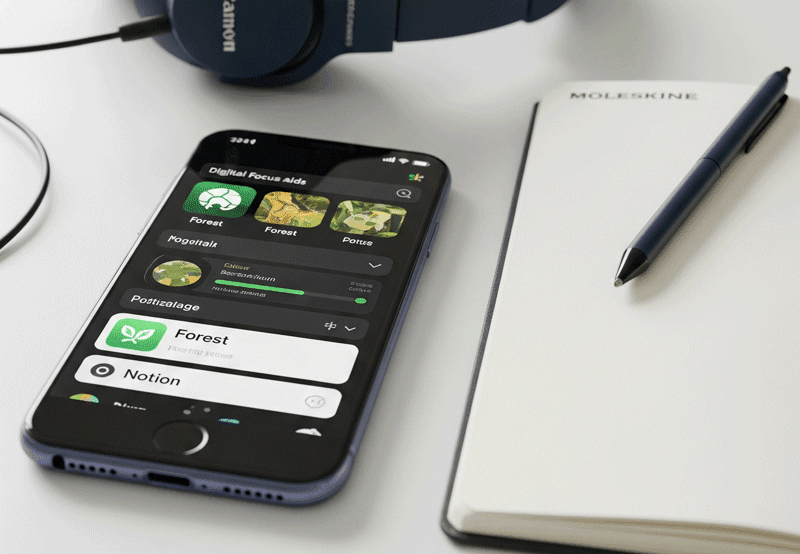
Use a simple rule: one screen, one purpose. If you need a computer, open only the tabs required for the task. If you need a phone for a timer or app, put it on focus mode and keep it face down. If you need online research, write the exact question before opening the browser so you do not wander.
7. Use a Distraction List
When a random thought appears, do not fight it for five minutes. Write it on a distraction list and return to work. The list can include anything: “reply to message,” “look up headphones,” “pay bill,” “check exam date,” or “watch that video later.”
This works because the mind relaxes when it knows the thought is captured. You are not ignoring the idea forever. You are choosing not to let it interrupt the current block.
8. Match the Method to the Task
Different tasks need different focus methods. Memorizing vocabulary, solving physics problems, reading a dense chapter, writing an essay, and reviewing lecture slides do not use attention in the same way.
| Task | Best focus method | Common mistake |
|---|---|---|
| Memorization | Flashcards, spaced review, active recall | Rereading the same list passively |
| Problem solving | Timed practice, error review, worked examples | Watching solutions without trying first |
| Reading | Questions before reading, summary after each section | Highlighting too much |
| Writing | Outline first, draft second, edit last | Editing every sentence while drafting |
9. Use Breathing to Reset Attention
Stress makes concentration harder because the body stays alert for threat instead of settling into the task. A simple breathing reset can help before a study block or after a frustrating mistake.
Try this: inhale through the nose for four counts, exhale slowly for six counts, and repeat for one to three minutes. Keep the shoulders relaxed. The point is not to force a dramatic state change. It is to slow down enough to return to the next useful action.

For more options, see deep breathing exercises for calm.
10. Protect Sleep, Food, and Movement
Focus is not only a study technique. It is also an energy problem. Sleep loss, dehydration, skipped meals, and sitting for hours can make concentration feel impossible even when your intentions are good.
Keep the basics boring and consistent. Sleep at a realistic time. Eat before long sessions. Keep water nearby. Move between blocks. Do not rely on caffeine to cover every weakness in the system. Caffeine can help alertness, but it cannot replace sleep or a workable schedule.
What to Do When Focus Still Fails
Some days will be messy. When focus fails, shrink the task instead of quitting. Study for 10 minutes. Solve one problem. Make one flashcard set. Read two pages. Clean the desk. Open the document and write the first bad sentence. Momentum often returns after the task becomes small enough to start.
If concentration problems are severe, long-lasting, or affecting school, work, sleep, mood, or daily life, it may be worth talking with a qualified professional. Stress, anxiety, depression, ADHD, sleep disorders, and health issues can all affect attention. A study trick is not a substitute for care when something deeper is going on.
Build a Repeatable Study Routine
Focus improves faster when studying has a repeatable starting ritual. The ritual should be short enough that you actually use it. For example: clear the desk, fill water, open the exact material, set a timer, write the target, and begin. When this sequence becomes familiar, you spend less energy negotiating with yourself.
A routine also makes focus easier on low-motivation days. Motivation changes. A routine reduces how much you depend on motivation. You may not feel ready, but the first step is already defined. That is often enough to begin.
Use Review Blocks, Not Only Learning Blocks
Many students spend most of their time learning new material and very little time reviewing old material. That creates a weak feeling of progress: you move forward, but the older material fades. A better weekly plan includes both learning blocks and review blocks.
A review block can be simple. Rework missed questions. Test yourself on last week’s notes. Explain an old topic from memory. Redo the hardest examples without looking. Review blocks protect concentration because they reduce panic before exams. When older material stays fresh, new material becomes easier to connect.
Make Hard Tasks Visible
If a subject feels impossible, it often helps to write down the exact source of difficulty. “I am bad at chemistry” is too broad. “I do not understand how to balance redox equations” is workable. “I cannot focus on essays” is broad. “I do not know how to start body paragraphs” is workable.
Specific difficulty gives your focus a direction. You can find one example, ask one question, watch one explanation, or practice one skill. Vague frustration creates avoidance because the problem feels bigger than the next step.
Protect the First Five Minutes
The first five minutes decide whether many sessions succeed. Do not start by checking messages, arranging playlists, cleaning unrelated areas, or opening five tabs. Start with the task while the intention is still fresh. If the session is supposed to be math, write the first problem. If it is reading, read the first paragraph and write a question. If it is writing, type a rough first sentence.
Once you begin, the mind often settles. Starting is not the whole battle, but it removes the most common place where attention leaks away.
Track Focus Without Overcomplicating It
You do not need a detailed productivity dashboard. A small note is enough. At the end of a session, write the subject, the time spent, what you finished, and one thing that distracted you. After a week, patterns appear. Maybe the phone is the main issue. Maybe late-night studying fails. Maybe one class needs more active recall. Maybe you focus best after movement.
This kind of tracking is useful because it turns focus into feedback. You stop guessing and start adjusting. The goal is not to judge yourself. The goal is to make the next study block easier than the last one.
Fix the First Five Minutes Before Fixing the Whole Day
Focus often fails before the study session really starts. The desk is open, the material is vague, the phone is close, and the first action is unclear. A small start ritual removes enough friction to make the first five minutes easier.
- Name the output: solve five problems, outline one section, or review one page.
- Remove the obvious switch: put the phone away before the timer starts.
- Open the exact material: do not let the first step be searching for notes.
- End with a restart cue: write the next action before the break.
This is educational study and wellness guidance, not medical, mental health, or professional advice.
- If the task feels vague, use mental models to choose the right lens.
Source note: for a broad health-oriented baseline on concentration habits, Harvard Health’s tips to improve concentration are a useful reference.
Bottom Line
To improve focus and concentration, make attention easier to protect. Define the task, remove obvious distractions, work in short blocks, use active recall, manage digital switching, take real breaks, and support the body with sleep, food, movement, and breathing.
The goal is not perfect focus all day. The goal is more high-quality minutes on the work that matters. If you can protect one focused block, you can repeat it. That is how concentration becomes a system instead of a mood.
Focus Improves When Decisions Are Removed
Studying with focus is easier when the session has fewer open choices. Decide the topic, time block, first task, materials, and stopping point before the session starts. That turns focus into a system instead of a mood. It also connects with habit stacking, because the same setup cue can make each study block easier to start.
Better focus also depends on protecting attention outside the session. Cleaner email boundaries, fewer notifications, and better sleep quality make it easier to use active recall, practice questions, and review without relying only on motivation.