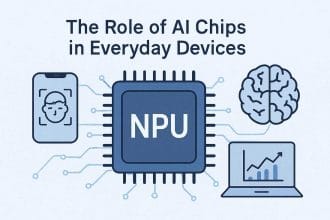






Artificial intelligence isn’t just some abstract concept anymore. It’s in your phone, your car, your smart home devices, making daily life smoother and smarter. But for AI to do its best work, it needs serious power. Not just raw speed, but a specific kind of intelligence from the chips it runs on. This is where intelligent processors come into play – the specialized brains behind tomorrow’s AI.
Think of it like this: your regular computer processor (CPU) is a jack-of-all-trades. It’s great at handling many different tasks, one after another. But AI, especially advanced AI, has very particular needs. It crunches huge amounts of data, looking for patterns, making predictions, and understanding complex information. For this, we need processors built from the ground up to handle these kinds of computations efficiently. These are the Future AI Processors, and they’re quietly revolutionizing how we interact with technology.
TL;DR
- Intelligent processors are specialized chips designed for AI tasks.
- They’re crucial for making AI faster, more efficient, and more private.
- NPU technology (Neural Processing Units) is a key innovation for AI acceleration.
- Next-gen AI chips are bringing powerful AI capabilities directly to your devices.
- Edge AI processing means AI works on devices, not just in the cloud.
- These advancements impact everything from smartphones to healthcare and autonomous vehicles.
- Understanding them helps you appreciate the tech driving our future.
The Brains Behind the Breakthroughs
So, what exactly are these ‘intelligent processors’? They aren’t just faster versions of the chips we’ve always used. Instead, they feature unique architectures specifically designed to accelerate AI workloads. Where a traditional CPU excels at sequential tasks, AI chips are built for parallel processing – handling many calculations simultaneously, which is exactly what AI models need when they’re learning or making decisions.
A major player in this field is NPU technology, or Neural Processing Units. NPUs are custom-built accelerators for neural networks, which are the backbone of most modern AI. Imagine training a dog: you show it hundreds of pictures of dogs, and eventually, it learns what a dog looks like. An NPU does something similar, but with digital data. It’s incredibly good at repetitive calculations that AI uses for tasks like image recognition, natural language processing, or predicting your next text word.
Next-Gen AI Chips: Powering Devices Everywhere
We’re moving into an era where Next-gen AI chips are not just confined to massive data centers. They’re making their way into the devices you use every day. This shift is enormous. Instead of sending all your data to the cloud for AI processing and then waiting for a response, your device can handle much of that work itself. This is what we call Edge AI processing.
Edge AI means the ‘intelligence’ is right there, at the ‘edge’ of the network – in your smartphone, a smart speaker, a factory robot, or an autonomous vehicle. This has several big advantages:
- Speed: No internet lag. Decisions are made instantly, which is critical for things like self-driving cars.
- Privacy: Your sensitive data might not need to leave your device, enhancing security and privacy.
- Efficiency: Less data needs to be sent back and forth, saving bandwidth and power.
Think about your phone recognizing your face to unlock. That’s often Edge AI in action, powered by an intelligent processor. Or your smart camera identifying a package delivery. It’s all happening locally, thanks to these specialized chips. You might be surprised by how much AI chip progress is shaping our world, often without us even realizing it.
- Pro-Tip: When looking at new devices like smartphones or laptops, check if they mention dedicated AI accelerators or NPUs. This often indicates better performance for AI-driven features like advanced photography, voice assistants, or smart software functions.
- Common Pitfall: Don’t assume ‘faster’ means ‘smarter’ in the context of AI. A general-purpose processor might have a high clock speed, but a lower-speed NPU can outperform it significantly for specific AI tasks due to its specialized design.
Real-World Impact on Our Lives
The rise of intelligent processors means AI is becoming more capable and integrated into our daily routines. Here’s a glimpse of the practical ways these chips are making a difference:
- Smarter Smartphones: Beyond face unlock, intelligent processors enable real-time language translation, advanced computational photography (making your photos look incredible), and personalized digital assistants that truly understand you.
- Advanced Healthcare: AI-powered chips can help process medical images faster, assisting doctors in early disease detection. They can also power wearable devices that monitor health metrics with greater accuracy, potentially predicting issues before they become serious.
- Autonomous Vehicles: This is a huge area. Self-driving cars rely on instant decision-making. Edge AI processing chips analyze sensor data – from cameras, radar, and lidar – in real-time, allowing the car to perceive its environment, predict actions, and navigate safely without constant cloud communication.
- Enhanced Security: From intelligent surveillance cameras that can identify unusual activity to smart home hubs that detect intruders more reliably, these processors make our environments safer.
- Personalized Experiences: Whether it’s streaming services recommending exactly what you want to watch or smart home devices anticipating your needs, intelligent processors are key to delivering truly personalized and intuitive interactions.
The beauty of these processors is their efficiency. They allow complex AI to run on devices without draining batteries excessively or requiring constant internet connections. This democratizes AI, bringing powerful capabilities to more people in more places.
Common Misconceptions
- Intelligent processors are just for experts or scientists. No, they are increasingly found in everyday consumer electronics.
- They make AI ‘think’ like a human. They accelerate complex calculations and pattern recognition, but they don’t possess consciousness or human-like understanding.
- You need to buy a whole new device to experience AI processors. While new devices offer the latest tech, many existing smartphones and laptops from the past few years already incorporate some form of AI acceleration.
- All AI processing has to happen in the cloud. Edge AI processing, powered by these chips, brings significant AI capabilities directly to your device, often for privacy and speed reasons.
Next Steps
As Future AI Processors become more prevalent, understanding their role helps us appreciate the rapid advancements in technology. Here’s how you can stay informed and leverage this evolution:
- Observe Your Devices: Pay attention to the AI features in your current smartphone, smart home gadgets, or car. Notice how they learn and adapt, which is often a sign of intelligent processing at work.
- Stay Curious: Follow tech news about new chip announcements, especially those from companies like Apple, Qualcomm, Google, and Intel, who are heavily investing in NPU technology and next-gen AI chips.
- Consider AI Capabilities: When buying new electronics, think beyond just raw speed. Look for mentions of dedicated AI accelerators or NPUs if AI features are important to you.
- Think About Privacy: Appreciate how Edge AI processing on intelligent processors can enhance your data privacy by keeping more information local on your device.