





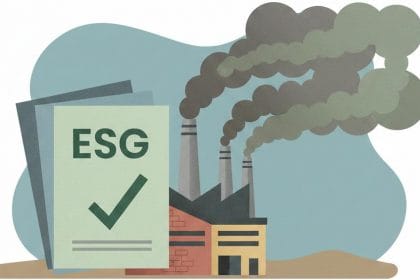
Investors increasingly rely on ESG ratings to guide their decisions. Funds labeled as “sustainable” attract large capital flows, and ESG metrics are now embedded into portfolio construction across global markets. Yet growing evidence suggests that ESG scores can mislead investors, and this is not a fringe concern. It is a structural problem.
On paper, ESG scores promise clarity. In practice, they often distort reality. This article takes a data-driven look at why ESG ratings often fail to measure real sustainability outcomes, and how they can steer investors toward false confidence.
What ESG Scores Are Supposed to Measure
ESG stands for Environmental, Social, and Governance. ESG scores aim to quantify how well a company manages non-financial risks that could affect long-term performance.
- Environmental: emissions, resource use, climate policies
- Social: labor practices, diversity, supply chains
- Governance: board structure, executive pay, shareholder rights
In theory, higher scores should reflect stronger sustainability practices. In reality, ESG ratings often measure policies, reporting quality, and disclosure completeness more than real-world outcomes.
While ESG frameworks try to quantify sustainability performance, actual environmental impact depends on measurable actions and outcomes, not just disclosures. For a practical example of outcome-focused sustainability thinking, see Top 10 Eco-Friendly Inventions That Could Actually Save the Planet.
Why Investors Trust ESG Ratings
ESG scores are popular because they simplify complex information. Instead of analyzing hundreds of data points, investors get a single number or rating tier. Asset managers use these scores to market “responsible” products, while institutions use them for screening and portfolio construction.
The problem is not investor intent. The problem is that ESG scores often feel scientific, objective, and precise, even when the underlying methodology is inconsistent, opaque, and assumption-heavy.
The Lack of Standardization in ESG Methodologies
One major reason ESG scores mislead investors is the absence of global standardization.
Different ESG rating agencies use different models and weightings:
- Some emphasize carbon intensity
- Others focus more on governance structure
- Many reward disclosure quality more than actual performance
As a result, the same company can receive:
- A top-tier ESG score from one provider
- A below-average score from another provider
Studies and industry analysis have repeatedly shown that ESG score correlations across major providers are much lower than credit ratings. This ESG rating divergence makes comparability weak and reduces reliability for investment decisions.
Self-Reported Data and Greenwashing Risks
Most ESG data originates from company disclosures, sustainability reports, and corporate statements. This creates two major weaknesses:
- Selective disclosure: Companies can highlight positives and downplay negatives
- Narrative advantage: Strong PR and reporting teams can outperform firms with better real-world impact
Because many ESG agencies depend heavily on reported data, companies skilled at disclosure can receive stronger scores than companies creating more measurable impact. This is one of the clearest pathways through which ESG metrics mislead investors.
This problem is closely related to greenwashing, where sustainability messaging looks stronger than the underlying environmental reality.
Modeled and Estimated ESG Data
When disclosures are incomplete, ESG providers often fill gaps with modeled estimates and assumptions. In some markets and sectors, a meaningful share of ESG indicators may be estimated rather than directly measured.
Investors rarely know:
- Which data points are directly reported and verifiable
- Which values are modeled estimates
- How much uncertainty exists in the final ESG score
This lack of transparency weakens ESG credibility and increases the risk of mispricing companies based on confidence that the data cannot support.
High ESG Scores for High-Polluting Companies
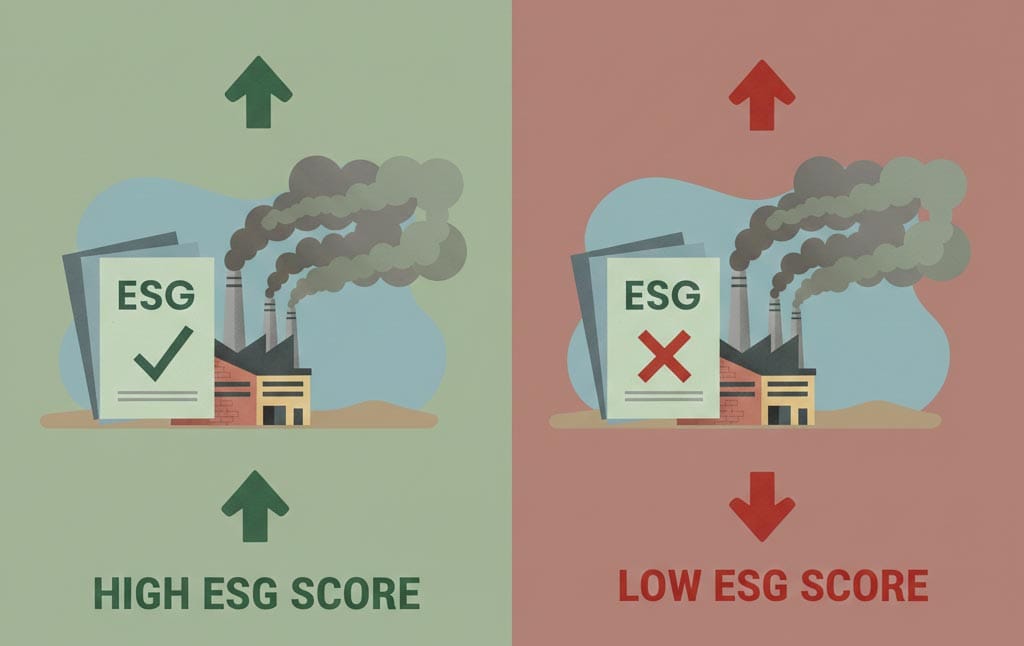
One of the most visible contradictions in ESG investing is that some major polluters still maintain strong ESG ratings.
Why does this happen? Because many ESG scores emphasize risk management quality rather than absolute environmental impact.
A fossil fuel company with:
- Detailed climate disclosures
- Formal emissions targets
- Strong governance controls
can outscore a smaller renewable or industrial firm that has weaker reporting systems but stronger real-world outcomes. This is a textbook case of ESG scores misleading investors by rewarding structure over substance.

ESG Risk Scores vs. Impact Scores: A Critical Distinction
Many investors assume an ESG score reflects how sustainable a company is. In many cases, it actually reflects how well the company manages sustainability-related risks to its own business model.
That is a very different question.
- Risk-focused ESG score: How exposed is the company to ESG-related financial and reputational risks?
- Impact-focused assessment: How much environmental or social harm (or benefit) does the company create in the real world?
Confusing these two concepts is one of the biggest reasons investors end up with portfolios that look sustainable on paper but fail to match their actual values or impact goals.
Social Scores: Policies vs. Reality
Social metrics often prioritize documented policies over lived outcomes.
A company may score highly for:
- Diversity policies
- Codes of conduct
- Training programs and formal commitments
Yet still face:
- Workplace discrimination claims
- Unsafe conditions
- Supply chain labor abuses
Because many ESG frameworks reward documentation and disclosure practices, ESG scores can fail to capture actual social outcomes, especially across complex global supply chains.
For readers interested in practical sustainability behavior at the individual level, see 10 Simple Steps to a Zero Waste Lifestyle.
Governance Scores and False Confidence
Governance scores typically emphasize board independence, committee structures, executive compensation frameworks, and shareholder rights. These are important signals, but they do not guarantee ethical conduct or good long-term decision-making.
Corporate history shows that serious scandals can occur at firms that previously scored well on governance checklists. This gap illustrates the limits of checkbox-based ESG evaluation and the danger of treating governance scores as proof of trustworthiness.
Does ESG Improve Financial Performance?
Research on ESG and financial returns remains mixed. Some studies suggest modest risk reduction in certain contexts, while others show no consistent outperformance once sector exposure, valuation, and methodology differences are considered.
What ESG ratings may do reasonably well:
- Flag reputational and regulatory exposure
- Provide a rough screening layer for governance and disclosure quality
What ESG ratings often do poorly:
- Measure real-world impact accurately
- Predict long-term sustainability outcomes consistently
- Support direct apples-to-apples comparison across providers
This gap explains why ESG scores can mislead investors who expect both ethical alignment and dependable outperformance from a single rating system.
Portfolio Risks Created by ESG Scores
When ESG ratings are embedded into ETFs, indexes, and model portfolios, methodology weaknesses scale quickly.
Common portfolio risks include:
- Overexposure to firms with strong reporting and branding
- Underexposure to impactful firms with weaker disclosure systems
- False confidence in sustainability alignment
- Hidden concentration risk driven by methodology bias
Investors may believe their portfolio reflects their values, while the underlying holdings reflect scoring mechanics more than real impact.
Better Alternatives to Traditional ESG Scores
Instead of relying only on headline ESG ratings, investors can use a more robust framework built around outcomes and verification.
- Impact-based metrics such as absolute emissions, injury rates, and verified supply chain incidents
- Third-party audits and assurance reports
- Regulatory-verified disclosures where available
- Engagement-based analysis that evaluates company responses over time
- Provider comparison rather than single-score dependence
These approaches focus more on outcomes than narratives and reduce the risk of letting misleading ESG ratings drive capital allocation decisions.
What Investors Should Do Differently
Smart investors should treat ESG scores as a starting point, not a final verdict.
Better practice includes:
- Combining ESG with fundamental analysis
- Reading sustainability reports critically, not passively
- Comparing absolute impact metrics, not only relative ESG ranks
- Checking whether the score reflects risk management or real-world impact
- Comparing multiple providers before making allocation decisions
ESG should help investors ask better questions. It should not replace judgment.
Frequently Asked Questions (FAQs)
Why are ESG scores inconsistent?
Because rating agencies use different methodologies, datasets, weightings, and assumptions. The same company can be scored very differently across providers.
Are ESG scores completely useless?
No. They can be useful as a screening tool for disclosure quality and some risk signals. The problem starts when investors treat them as a full measure of sustainability impact.
Do high ESG scores mean a company is sustainable?
Not necessarily. A company can score well by managing ESG-related risks and disclosures while still causing significant environmental or social harm.
Can ESG scores mislead retail investors?
Yes. Retail investors often rely on simplified labels and score-based products, which can create false confidence if the methodology and limitations are not clearly understood.
Is greenwashing linked to ESG ratings?
Often, yes. If a rating system rewards disclosure and narrative quality more than verified outcomes, strong sustainability messaging can translate into better scores without equivalent real-world improvement.
What should investors use instead of a single ESG score?
A combination of verified impact metrics, third-party audits, provider comparisons, and fundamental analysis is usually more reliable than relying on a single ESG rating.
Conclusion: Sustainable on Paper, Risky in Reality
ESG scores were designed to help investors align capital with sustainability and risk awareness. In practice, they often reward disclosure quality, policy structure, and reporting sophistication more than measurable outcomes. As long as ESG frameworks continue to prioritize documentation, modeling, and methodology-specific assumptions over real-world impact, ESG scores will continue to mislead many investors.
Better sustainable investing requires deeper analysis, better data, and a willingness to look beyond the score.
External reference: For further discussion on ESG rating divergence and methodology inconsistency, review analysis and commentary from MIT Sloan Management Review.