




Quantum computing. Sounds like something straight out of a sci-fi movie, doesn’t it? For many of us, it conjures images of hyper-advanced machines solving problems we can’t even grasp. And while it is incredibly advanced, the core ideas behind it aren’t as alien as they seem. You don’t need a physics degree to understand the basics. Think of this as your friendly guide to demystifying the fundamental concepts that make quantum computers tick. We’re going to break down the big ideas, the quantum mechanics fundamentals, into something you can actually wrap your head around, exploring what makes this technology so revolutionary.
TL;DR
- Quantum computing uses quantum mechanics fundamentals for processing information differently than classical computers.
- The basic unit is a qubit, which can be 0, 1, or both simultaneously (superposition).
- Superposition and entanglement are key quantum phenomena allowing for immense computational power.
- Entanglement links qubits, so the state of one instantly affects others, even at a distance.
- Unlike classical bits, qubits don’t just process in parallel; they explore all possibilities at once.
- Qubit technology is still evolving but holds promise for complex problem-solving.
- It’s not about replacing your laptop; it’s about tackling problems currently impossible for any computer.

The Quantum Leap: Beyond Bits and Bytes
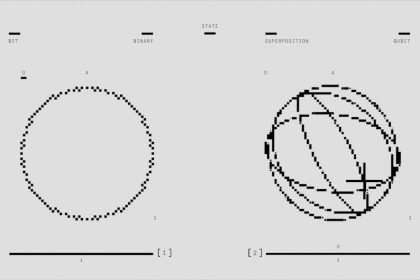
First, let’s ground ourselves in what we already know. Your laptop, your phone – they all operate on something called classical computing. Basically, it uses bits. A bit is like a light switch: it’s either ON (1) or OFF (0). Simple, effective.
Now, enter qubit technology. A qubit (pronounced ‘cue-bit’) is the quantum equivalent of a bit, but it’s far more flexible. For example light switch again. A classical bit is definitely on or definitely off. A qubit, thanks to quantum mechanics fundamentals, can be both on and off at the same time. Not a little bit on and a little bit off, but genuinely existing in a blend of both states simultaneously. This bizarre-sounding concept is called superposition.
Think of it like a spinning coin. While it’s mid-air, it’s neither heads nor tails; it’s a bit of both. Only when it lands (when you ‘measure’ it) does it decide. Qubits work similarly. They hold multiple possibilities until they’re observed. This ‘both at once’ capability allows a single qubit to store far more information than a single classical bit. Two classical bits can be 00, 01, 10, or 11 – one of four states at a time. Two qubits in superposition can hold all four states simultaneously. The computational power grows exponentially with each added qubit, which is where the magic really starts to happen.
Then there’s entanglement. If superposition is weird, entanglement is truly mind-bending. Imagine you have two coins, and you spin them. You don’t know if they’re heads or tails until they land. But with entangled coins, if you observe one and it lands heads, you instantly know the other one must be tails, no matter how far apart they are. They’re linked in such a fundamental way that measuring one instantly influences the other, even if they’re light-years apart. This ‘spooky action at a distance,’ as Einstein called it, allows quantum computers to perform computations that are incredibly complex and interconnected. Entangled qubits aren’t just working in parallel; they’re intrinsically connected, working as one vast, intertwined system.
- Pro-Tip: Don’t try to visualize superposition or entanglement with everyday objects too literally. They are phenomena unique to the quantum world, and our brains struggle because we’re used to a classical reality.
- Common Pitfall: Confusing quantum computing with simply faster classical computing. It goes beyond speed; it’s about solving different types of problems, often those intractable for even the most powerful supercomputers.
Why It Matters: The Power of Quantum Computing Principles
So, why go through all this trouble to create these bizarre machines? Because these unique quantum mechanics fundamentals unlock computational power that can tackle problems classical computers simply can’t. While your everyday tasks – browsing the web, running spreadsheets – will always be handled perfectly fine by your current devices, quantum computing is being designed for a specific class of incredibly complex challenges.
Imagine designing new materials at the atomic level, simulating complex chemical reactions for drug discovery, or breaking modern encryption by factoring massive numbers. These are the kinds of grand challenges where quantum computers could shine. They don’t just try every possible solution one by one; thanks to superposition, they can explore many, many possibilities simultaneously, like running a million experiments at once, then letting entanglement weave those results together into a coherent answer.
The field is still in its early stages, but the potential is enormous. If you’re curious about what this could mean down the line, understanding Quantum Computing’s Future provides even more context into the revolutionary changes we might see. It’s not about making your phone faster; it’s about solving problems fundamental to science, medicine, and technology that are currently beyond our reach.
Real-World Impact on Your Life (Eventually)
While quantum computers aren’t going to replace your smartphone next year, their eventual impact will ripple through society in significant ways. Think about breakthroughs in medicine: faster drug discovery could mean treatments for diseases that are currently incurable. Materials science could see new superconductors or super-efficient batteries, changing everything from energy storage to transportation.
In the realm of security, quantum computing presents a dual challenge and opportunity. It could, in theory, break many of the encryption methods we rely on today, but it also paves the way for ‘quantum-safe’ encryption, ensuring our data remains secure in a quantum future. Weather forecasting, financial modeling, optimizing supply chains – almost any field dealing with massive, interconnected data points could see transformative benefits. It’s about opening doors to solutions we haven’t even conceived of yet, all thanks to leveraging those strange quantum computing principles.
- Pro-Tip: Don’t panic about your data being instantly vulnerable. Experts are already working on quantum-resistant encryption methods, a testament to how seriously the scientific community takes this technology.
Common Misconceptions
- Quantum computers aren’t just ‘faster’ versions of traditional computers. They process information differently, excelling at specific types of complex problems rather than general-purpose tasks.
- They won’t be in your home anytime soon. These machines are complex, require extremely cold temperatures (colder than outer space), and are incredibly expensive to build and maintain.
- Quantum computers don’t solve every problem. While powerful for certain tasks, classical computers remain superior for many routine computational challenges.
- The term ‘quantum’ isn’t just a buzzword. It refers directly to the use of specific quantum mechanics fundamentals that govern the universe at its smallest scales.
- Quantum computing is not magic. It’s based on well-established scientific principles, albeit principles that often defy our everyday intuition.
Next Steps
The world of quantum computing principles is vast and fascinating, but hopefully, this primer has made it a bit less intimidating. Here are some ways you can continue to explore this groundbreaking field:
- Read More: Look for introductory articles or videos from reputable science and tech publications that aim to demystify complex topics.
- Follow Experts: Keep an eye on major tech companies and research institutions working in quantum computing for updates on breakthroughs and developments.
- Experiment (Virtually): Some platforms offer quantum computing simulators online where you can play with basic quantum concepts without needing a supercomputer.